
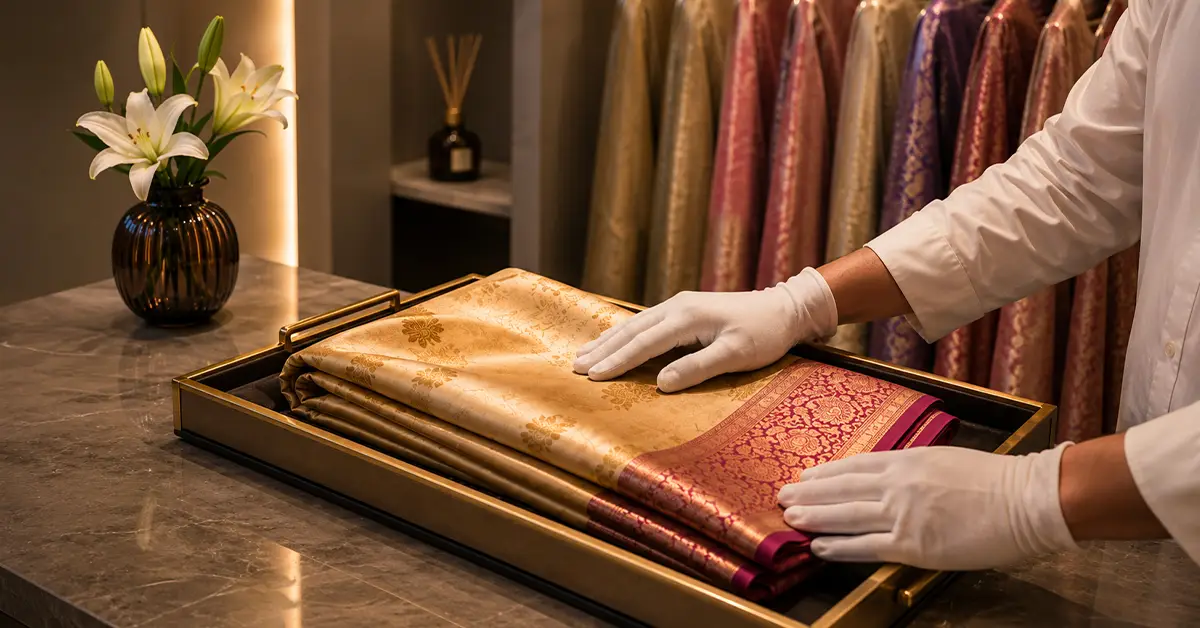
Saree Dry Cleaning Mistakes That Fade Colour Faster Than Expected
You pull out the maroon Banarasi you wore at your cousin’s wedding. It’s clean. You had it cleaned right after the function and put it away properly. But the red isn’t the red you remember. It has gone flat, half a shade closer to brown, and the zari border looks tired instead of bright.
Nobody spilled anything on it. It faded quietly, over a couple of years of what felt like careful handling.
That’s the annoying thing about saree colour loss. It rarely happens in one dramatic accident. It happens in small steps, and most of those steps are things we do while believing we’re protecting the fabric.
Washing it at home “just this once”
Almost every silk saree that lost its colour in a bucket was washed by someone being very careful. Cold water, a capful of mild shampoo, no wringing. The effort isn’t the problem. The water is.
Most traditional saree dyes are not fully colour-fast, and deep shades are the worst offenders. Reds, maroons, indigos and rani pinks start releasing dye the moment they sit in water. You rarely see it in the bucket. You see it later, when the pallu is visibly lighter than the body.
Cotton and linen sarees can usually handle a gentle home wash. Silk, chiffon, georgette, organza and anything with zari cannot be treated like a regular kurta.
Drying it in direct sunlight
Terrace drying feels safe because sunlight kills odour and dries fast. It also destroys colour. Two hours in an afternoon sun does more fading than months in a cupboard, because UV breaks dye molecules apart, and it does this unevenly, which is why one fold ends up paler than the rest. If a saree needs airing, hang it in shade with some breeze, and keep it off metal wires that leave rust marks.
Using a detergent bar or regular surf on a stain
Everyday detergents are alkaline, built to strip oil and grime off cotton. Zari is a metallic thread wound around a silk or cotton core, and alkaline detergent tarnishes it. That’s why the gold border on an old saree sometimes looks blackish along the edges, and once zari tarnishes, no amount of cleaning brings the shine back.
Rubbing a fresh stain right away
The instinct is to dip a napkin in water and scrub. Rubbing pushes the stain deeper into the weave and roughs up the surface fibres, and on silk that leaves a dull, faded patch even after the stain itself is gone. Blot gently instead, then get the saree to a professional while the stain is fresh. Fresh stains come out far more reliably than ones that have sat for six months and oxidised.
Storing sarees in plastic covers
Those transparent covers from the shop look protective, but they trap moisture. In our humidity that means mildew, musty smell, and a yellow cast on light-coloured silk. Wrap sarees in soft muslin or old cotton cloth instead, and refold them every few months so the same crease doesn’t weaken the fibre along one line.
Ironing directly at high heat
Direct high heat scorches silk, and a scorch shows up as a shiny, washed-out patch that cannot be reversed. It also flattens zari and crushes embroidery. Iron on the reverse side, at low heat, with a cotton cloth between the iron and the saree.
Putting it away dirty because it “looks fine”
This one causes more damage than any single wash. Sweat, perfume and deodorant residue sit invisibly in the fabric and oxidise over months into brownish-yellow marks around the underarms and pleats. The residue also attracts silverfish. A lot of sarees people describe as faded didn’t fade at all. They discoloured from the inside because they went into storage soiled. Clean a saree before you put it away for a long stretch, even if it looks fine.
Handing it to whoever is nearest and cheapest
Not every dry cleaner runs the same process. Older machines with tired, overused solvent redeposit dirt back onto the fabric and are rough on delicate fibres and unstable dyes. Cheap saree dry cleaning that comes back looking slightly grey or smelling of chemicals is usually a solvent problem. Ask what process a cleaner actually uses before you hand over an expensive piece.
How the team at Cosmos Laundry protects saree colour
Cosmos Laundry has been handling garment care for over 10 years, and the saree dry cleaning process is built around the exact failure points above.
Every saree is sorted by fabric first, because a Kanjeevaram, a chiffon and an organza saree each need a different approach. The team then runs a colour-fastness check on a hidden corner, so bright reds, maroons and indigos that tend to bleed get identified before cleaning starts. This is the single step home washing skips.
The cleaning itself uses hydrocarbon dry cleaning technology, a gentler solvent system that lifts dirt and odour without stripping dye. Zari borders and embroidered pallus are handled and pressed separately so the work stays crisp rather than flattened, and blouses and falls are cleaned along with the saree so the whole set stays even in colour.
On older stains, the team tells you upfront what is realistically removable rather than promising a result the fabric can’t deliver. Every garment is inspected before it goes back to you, and saree dry cleaning comes with doorstep pickup and delivery across Nashik, Jalgaon and Amravati. For heirloom pieces, the membership plans include garment insurance, which is worth knowing if your cupboard holds sarees you’d be heartbroken to lose.
Send your sarees in before the next function
If you have sarees you’ve been meaning to clean since the last wedding, don’t wait for the colour to tell you it’s too late.
Book a saree dry cleaning pickup with Cosmos Laundry. Call +91 90670 55586 (Nashik), +91 91561 29128 (Jalgaon) or +91 96978 95895 (Amravati), message us on WhatsApp, or schedule a doorstep pickup here. We’ll collect them from your door and return them the way you remember them.